

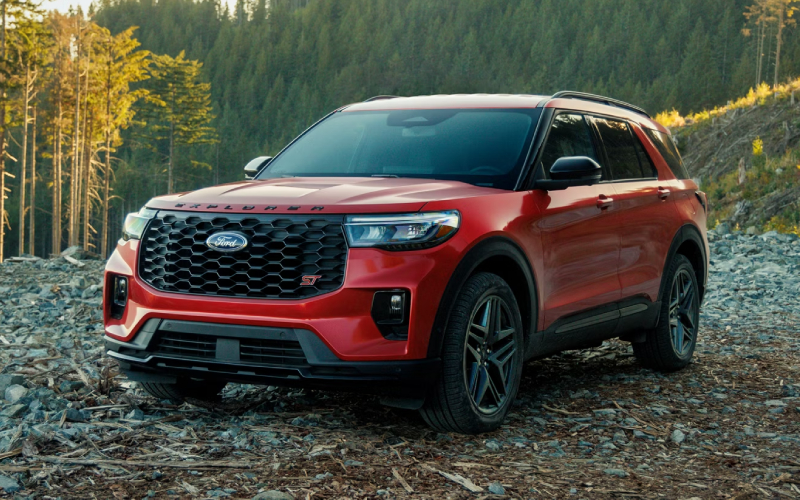
Capper Auto Group – Which three-row SUV offers better hands-free driving confidence around North English, IA: the 2026 Ford Explorer or 2026 Honda Pilot?
Hands-free driving is one of the most searched topics when families compare modern three-row SUVs. If you regularly shuttle kids, commute to larger hubs, or travel for weekend games and getaways, driver-assistance that genuinely reduces fatigue can be a must-have. In this comparison, we focus squarely on hands-free capability and the supporting tech that makes highway time calmer and more predictable—because that is where the hours add up for most families.
Ford BlueCruise is the feature that sets the tone. It is a hands-free highway driving assistance system available on select Explorer trims that helps with acceleration, braking, and steering on compatible sections of mapped highways while the driver remains attentive and monitors the road. This is an important distinction: BlueCruise goes beyond typical lane-centering plus adaptive cruise by allowing hands-free operation in qualifying conditions. The Honda Pilot, by contrast, provides Honda Sensing® with helpful features such as Adaptive Cruise Control with Low-Speed Follow, Lane Keeping Assist, and Traffic Sign Recognition. These are excellent assists, but they do not permit hands-free operation; the driver must keep hands on the wheel while the systems provide steering or speed support.
How hands-free tech changes highway time
For families who often drive between towns or along stretches of interstate, hands-free assistance can greatly reduce the micro-corrections and constant muscle tension of long trips. The practical effect is less fatigue, fewer lane-position adjustments, and steadier gap management around tractor-trailers or in thicker traffic. Paired with the Explorer’s RWD-based platform—which naturally lends a planted, composed feel at speed—BlueCruise contributes to a calmer cabin, making conversations easier and reducing stress as you near busier exits or construction zones.
The Pilot’s approach remains valuable: its lane-centering and adaptive cruise work smoothly, and the 10-speed transmission is refined. It simply takes a different path, supporting the driver rather than supplanting routine steering input. If you are comfortable with traditional advanced driver-assistance and do not need hands-free capability, Pilot’s suite will feel familiar and confidence-boosting. But if the goal is to remove a layer of workload from your highway routine, Explorer’s available BlueCruise is the difference-maker.
Beyond hands-free: supportive tech that matters
Hands-free is not the only piece of the puzzle. Vision and awareness systems help you position a larger SUV gracefully in traffic and in tight spaces. Explorer offers a 360-degree camera system on select trims, creating stitched views that simplify parking, school pickup lines, and angled driveways. Pilot counters with a Multiview Camera System and TrailWatch™ on TrailSport and above, which is especially helpful on narrow trails or when picking a line in a rugged parking area for outdoor events. Both are genuinely useful, but families who split time between city errands and rural destinations may prefer the Explorer’s broader availability across street-focused trims.
Cabin tech also plays a supporting role during long days behind the wheel. Explorer’s Ford Digital Experience streamlines navigation, media, and app access, while available B&O® Sound System by Bang & Olufsen® with a subwoofer keeps podcasts and playlists rich and clear. Pilot offers Google built-in, wireless smartphone mirroring, and on upper trims a Bose premium sound system; these are excellent features in their own right. The tie-breakers often come down to ergonomic details—how quickly you can adjust settings, whether voice prompts are intuitive, and how natural the screen layout feels on the move.
Power and composure when the miles stack up
While our focus is hands-free confidence, it is fair to ask how powertrains support relaxed highway pacing. Explorer’s available 3.0L EcoBoost® V6 in the ST trim brings up to 400 horsepower, giving you ample reserve for passing and merging. Even the standard 2.3L EcoBoost® I-4 delivers robust midrange torque, helpful when joining fast-moving lanes. Pilot’s single 285-hp V-6 is smooth and well-matched to family use, though it does not offer the same surge for quick passes. On windy days or when towing small weekend gear, the Explorer’s RWD platform and available performance hardware contribute to a steadier, more settled feel in crosswinds or when the vehicle is fully loaded.
- Hands-free capability: Explorer offers Ford BlueCruise on select trims for true hands-free highway assistance; Pilot’s Honda Sensing® provides robust assists but does not enable hands-free operation.
- Highway composure: Explorer’s RWD-based architecture and available 400-hp 3.0L EcoBoost® V6 support confident merging and passing; Pilot’s V-6 is smooth but less powerful.
- Camera systems: Explorer’s available 360-degree camera helps in parking lots and tight streets; Pilot’s Multiview Camera with TrailWatch™ shines on narrow trails and rougher paths.
If your daily life mixes work commutes, school routes, and regular trips along I-80 and IA-1, Explorer’s hands-free capability and chassis composure can make a meaningful difference in how you feel at the end of the day. For buyers who prioritize traditional driver assists and cabin flexibility without hands-free needs, Pilot remains a strong contender.
At Capper Auto Group, our team welcomes side-by-side test drives focused on your exact use case—rush-hour stretches, weekend highway miles, and the neighborhood maneuvers you do every day. With routes that mimic your routine, you will get a real sense of how hands-free assistance changes your highway rhythm compared with conventional lane-centering. We are committed to practical, transparent guidance so you can choose the three-row SUV that actually supports your life, not just your wish list.
Frequently Asked Questions:
Does hands-free driving mean the vehicle is autonomous?
No. Explorer’s available Ford BlueCruise is a driver-assistance feature. You must remain attentive, keep your eyes on the road, and be prepared to take control at any time, even when your hands are off the wheel on compatible highway sections.
Can I use hands-free assistance on every road?
BlueCruise operates on compatible, mapped highway sections. In city traffic, on rural two-lanes, or on roads without the necessary mapping and lane markings, the system will not provide hands-free operation and will prompt you to steer conventionally.
How do camera systems help on busy days?
Surround-view camera systems give you multiple angles that simplify parallel parking, navigating pick-up lanes, and positioning near curbs or trailheads, reducing guesswork and the need for repeated adjustments.
As a regional resource serving Washington, Williamsburg, and North English, we are happy to outline feature availability by trim so you can shop with clarity and confidence. Your time matters, and we will tailor the process to fit your schedule and priorities.
Request more 2026 Ford Explorer information
Connect with us

