

Capper Auto Group - Can the 2027 Ford Explorer tow and carry family gear around Williamsburg, IA?
The 2027 Ford Explorer gives Williamsburg-area shoppers a strong mix of towing capability, cargo flexibility, and three-row comfort in one SUV that is easy to use every day.
For many SUV buyers, the real question is not just whether a vehicle has three rows. The bigger question is whether it can handle a full schedule without constant compromises. Around Williamsburg, IA, that may include a commute along I-80, a run to school activities, a Saturday project, a family trip, or a drive to visit relatives in nearby communities. The Explorer® answers that kind of layered need with a maximum towing capacity of 5,000 lbs when properly equipped, available Intelligent 4WD, seating for six or seven, and up to 85.8 cu ft of cargo space depending on model.
What towing capability does the 2027 Explorer offer?
The 2027 Ford Explorer is rated for a maximum towing capacity of 5,000 lbs when properly equipped. That number matters because it puts useful weekend and family towing within reach. Shoppers considering a small utility trailer, lightweight boat, personal watercraft, compact camper, or gear trailer can look at the Explorer as more than a people mover. It is a three-row SUV with enough strength to support recreational plans and home projects while still feeling refined for everyday driving.
Engine choice also plays a role in how the Explorer feels while towing or carrying a full cabin. The 2.3L EcoBoost® I-4 engine is standard on Active, ST-Line, Tremor®, and Platinum™ models and delivers 300 hp. The 3.0L EcoBoost® V6 engine is standard on ST and available on Tremor® and Platinum™, giving shoppers access to stronger acceleration and up to 385 hp. For drivers who frequently travel with passengers, cargo, and a trailer, the added power of the V6 may be worth comparing during a test drive.
How much cargo room is available?
Cargo flexibility is one of the Explorer’s biggest strengths. Active and ST-Line models provide up to 85.8 cu ft of maximum cargo capacity, while Tremor®, Platinum™, and ST models provide up to 85.3 cu ft. With all seats in place, every Explorer model offers 16.3 cu ft behind the third row. That space is useful for groceries, backpacks, small coolers, sports bags, or everyday items when passengers are using all three rows.
The benefit grows when the third row is folded. PowerFold® third-row seats are available on Tremor® and standard on ST and Platinum™, making it easier to switch from passenger mode to cargo mode. This is especially valuable for households that move between people-hauling and gear-hauling throughout the week. A family may use all rows for a school event, then fold seats for luggage or home improvement supplies the next day.
Which Explorer models fit towing and cargo needs best?
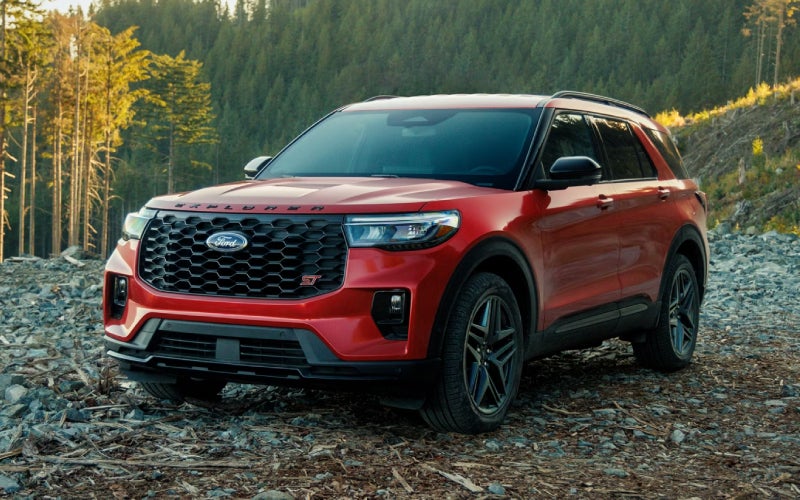
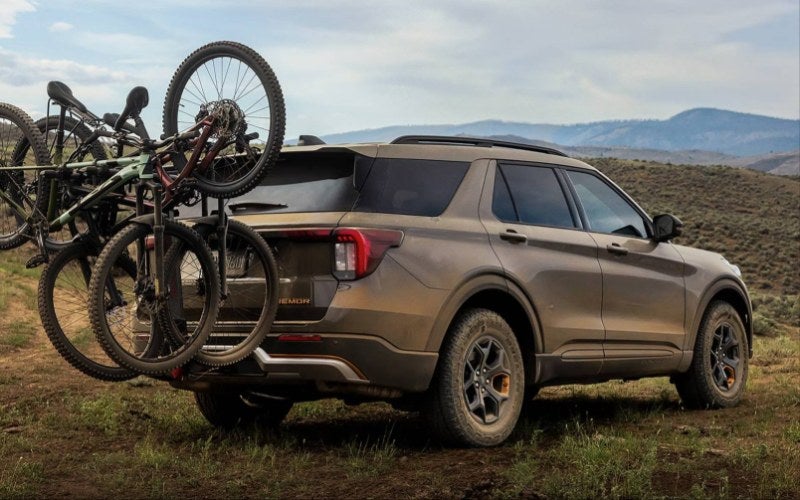
Every Explorer model has a clear role, so the best choice depends on how the SUV will be used most often. Shoppers who want the essentials with strong comfort may start with Active. Drivers who like a sport-inspired look may prefer ST-Line. Tremor® adds off-road-tuned suspension, increased ride height, underbody protection, and a Torsen® limited-slip rear axle, which can appeal to outdoor-focused owners. Platinum™ brings more luxury, and ST delivers the most athletic on-road character.
- Active: A strong starting point with the 2.3L EcoBoost® engine, heated front-row seats, Ford Co-Pilot360® driver-assist features, and the Ford Security Package.
- ST-Line: A style-forward model with unique cloth-trimmed seating with red stitching, available 360-degree camera, and B&O® Sound System by Bang & Olufsen®.
- Tremor®: A capability-focused model with available 3.0L EcoBoost® power, off-road-tuned suspension, increased ride height, and underbody protection.
- Platinum™: A premium choice with available 3.0L EcoBoost® power, heated, ventilated, massaging front-row seats, and available panoramic Vista Roof® with power shade.
- ST: A performance-focused Explorer with the 3.0L EcoBoost® engine, sport-tuned suspension, performance brakes, and available Sinister Package.
For towing and cargo, shoppers should look beyond the model name and focus on the exact equipment. Available Intelligent 4WD may be important for gravel lanes, boat ramps, job sites, or rural routes. Seating layout also matters. Second-row captain’s chairs are standard on all models and make third-row access easier, while an available second-row bench seat on all models except Tremor® raises seating capacity to seven.
What technology helps when hauling passengers and gear?
Technology can make a big difference when an SUV is full. Ford Co-Pilot360® Technology is designed to help drivers feel more confident behind the wheel, and available features such as a 360-degree camera can be especially helpful when parking, lining up near a trailer, or maneuvering in tight spaces. The Ford Digital Experience also supports daily usability by bringing familiar digital tools into the cabin.
Available Ford BlueCruise adds another layer of convenience for compatible highways. It helps control steering, braking, and acceleration and keeps the vehicle centered in its lane while the driver keeps eyes on the road ahead. For Williamsburg-area drivers who spend time on I-80 or longer highway routes, this available system can help reduce fatigue on compatible sections. It does not replace attentive driving, but it can make highway travel feel more relaxed.
How should shoppers test cargo and towing practicality?
A thoughtful test drive should include more than acceleration and steering feel. If the Explorer will serve as a family SUV, bring the items that represent real life. A child seat, stroller, golf clubs, sports bag, cooler, work tote, or folded chairs can show how the cargo area works in practical terms. Open the liftgate, fold the third row, test second-row access, and sit in each row if passenger comfort is a priority.
- Confirm seating layout: Compare standard second-row captain’s chairs with the available bench seat if seven-passenger capacity is important.
- Test cargo transitions: Fold the third row and second row to understand how quickly the Explorer changes from passenger space to cargo space.
- Discuss towing equipment: Ask which configuration supports the maximum 5,000-lb towing rating and what accessories may be recommended.
- Drive local-style routes: Include a mix of town streets, rural roads, and highway speeds to understand ride comfort and confidence.
- Review driver assistance: Try available camera views, Ford Co-Pilot360® settings, and the Ford Digital Experience during the visit.
This approach gives shoppers a clearer sense of whether the Explorer fits actual routines instead of only looking strong on paper. The right SUV should feel intuitive when loading cargo, comfortable when filled with passengers, and confident when merging or climbing grades with extra weight.
Frequently Asked Questions:
Is the 2027 Ford Explorer good for family road trips?
Yes. The Explorer offers three-row seating, available premium front-row comfort, useful cargo space, and available Ford BlueCruise for compatible highways. Active and ST-Line models provide up to 85.8 cu ft of maximum cargo space, while Tremor®, Platinum™, and ST provide up to 85.3 cu ft.
Can the 2027 Explorer seat seven people?
Yes. The Explorer seats six with standard second-row captain’s chairs, and a second-row bench seat is available on all models except Tremor® to increase capacity to seven. Every model includes a third row.
Which 2027 Explorer engine is best for towing?
The Explorer can tow up to 5,000 lbs when properly equipped. The standard 2.3L EcoBoost® I-4 offers strong everyday performance, while the available 3.0L EcoBoost® V6 on Tremor® and Platinum™ and standard V6 on ST may appeal to shoppers who want added power.
For Williamsburg, IA shoppers comparing three-row SUVs, the 2027 Ford Explorer stands out because it feels purpose-built for real schedules. It can carry people, adapt to cargo, support towing needs, and offer technology that makes daily driving easier. The best way to decide is to compare trims in person, test the seating and cargo layout, and choose the model that matches both weekday responsibilities and weekend plans.